FTSE Finish Line: June 5 — Inflation Relief Helps London Outperform, But Turns Negative On The Day
FTSE Finish Line: June 5 — Inflation Relief Helps London Outperform, But Turns Negative On The Day
The FTSE 100 rose on Friday, outperforming several global markets despite a broader risk-off tone, as investors took comfort from signs that the inflationary fallout from the Middle East energy shock may be less severe than feared. The blue-chip index was broadly unchanged, reflecting a market that was willing to reward inflation relief but still hesitant to add risk aggressively ahead of key data and central bank events. The main support came from the Bank of England’s latest Decision Maker Panel survey, which showed that British businesses expect to raise prices at a slower pace over the coming year than they had anticipated previously. Among more than 2,000 UK companies, 57% said they expected to lift prices in response to the energy shock, down seven percentage points from April. That decline suggested that some of the initial pressure from higher energy costs linked to the Iran conflict may be easing before it becomes fully embedded in corporate pricing behaviour. That mattered because the market’s biggest fear has not simply been higher oil prices, but a second-round inflation cycle where firms pass on energy costs, workers demand compensation, and the Bank of England is forced into a more aggressive tightening path. Paul Dales, Chief UK Economist, said the latest evidence appeared to support the view that labour-market weakness would prevent the second-round effects the BoE fears. For equities, that was enough to shift the balance slightly in favour of risk-taking, even as geopolitical risks remained elevated.The relief was only partial. Traders still expect the Bank of England to keep rates unchanged at 3.75% at its upcoming meeting, but markets continue to price one — and potentially two — quarter-point increases later this year. Governor Andrew Bailey has argued that the current energy shock is smaller than the one seen in 2022, while the UK labour market is weaker and interest rates are already higher. That gives the Bank room to wait, but not much room to sound relaxed. A clear MPC majority is likely to favour no change on 18 June, though the vote may not be unanimous. Recent comments from external member Megan Greene, warning about second-round inflation risks, suggest she could join Chief Economist Huw Pill in voting for a hike.
Global bonds remained under pressure as renewed Middle East tensions pushed oil prices higher and stronger U.S. data lifted market interest rates. Front-month Brent moved back toward $99 a barrel, up from last week’s $91 low, keeping the inflation risk premium alive. In the U.S., nonfarm payrolls rose by 172,000 in May, with prior readings revised higher, marking solid job gains for three consecutive months. That reinforced the view that the U.S. labour market remains resilient despite geopolitical uncertainty, pushing market pricing for a Federal Reserve hike sharply higher over the past month. A 25 basis-point Fed increase is now fully priced by year-end, supporting the U.S. dollar. In the UK, the final May composite PMI was revised up to 49.7 from 48.5, bringing it closer to the 50 no-change mark and suggesting that later survey respondents were more upbeat. But the details remained uneven. The construction PMI stayed weak at 38.2, pointing to continued stress in building activity, even if official data present a less negative picture. BoE monetary data also showed consumer credit flows remained relatively firm in April, suggesting households are still borrowing despite higher uncertainty and tighter financial conditions. Sector performance showed where investors were willing to lean. Technology stocks led the market, rising 2.1%, while personal care shares advanced 1.7%. Those gains helped lift the FTSE 100 even as the broader global backdrop was cautious. Precious metal miners underperformed, falling 2.2%, as the session’s rotation favoured earnings resilience and inflation relief over traditional safe-haven commodity exposure.
Geopolitics remained a live risk. Investors continued to watch the Middle East closely, with any progress toward an interim agreement between Washington and Tehran and the reopening of the Strait of Hormuz seen as crucial for limiting further economic fallout. Iran reaffirmed support for Hezbollah and called for Israel to withdraw from southern Lebanon, underscoring how difficult it remains to translate ceasefire diplomacy into a durable de-escalation. For markets, that means oil can still move sharply on headlines, keeping inflation expectations and rate pricing vulnerable. Domestic politics added another layer of uncertainty. Labour Mayor Andy Burnham said earlier this week that he would enter any leadership contest against Prime Minister Keir Starmer if he secured victory in a local election later this month. That kept Westminster risk in the background for investors already focused on growth, inflation and gilt-market sensitivity.
Attention now turns to next week’s data calendar. The key global release is U.S. CPI inflation on Wednesday, while the UK focus is April GDP on Friday. Markets expect UK GDP to fall 0.1% in April, mainly reflecting a reversal of front-loaded activity that boosted March output. Official retail sales declined in April, and NHS strikes are expected to weigh on services output, with services seen contracting around 0.2%. Even so, flat monthly growth in May and June would still leave second-quarter growth at around 0.2% quarter-on-quarter, a respectable outcome, though softer than the 0.6% expansion in the first quarter. Other releases include the University of Michigan U.S. consumer sentiment survey, Chinese inflation, German factory orders and industrial production, plus UK reports on jobs, retail sales and housing.
Finish Line: The FTSE 100 turned negative into the close following a reversal on Wall St down 0.45%, as the BoE’s business survey offered investors some relief that the Middle East energy shock may not be turning into a full second-round inflation cycle. Brent near $99, stronger U.S. payrolls, rising global yields and UK political uncertainty all kept the rally on a short leash. For now, London is outperforming because inflation fears have eased at the margin – but the next leg depends on whether oil, U.S. CPI and UK GDP allow the Bank of England to keep waiting rather than start tightening again.
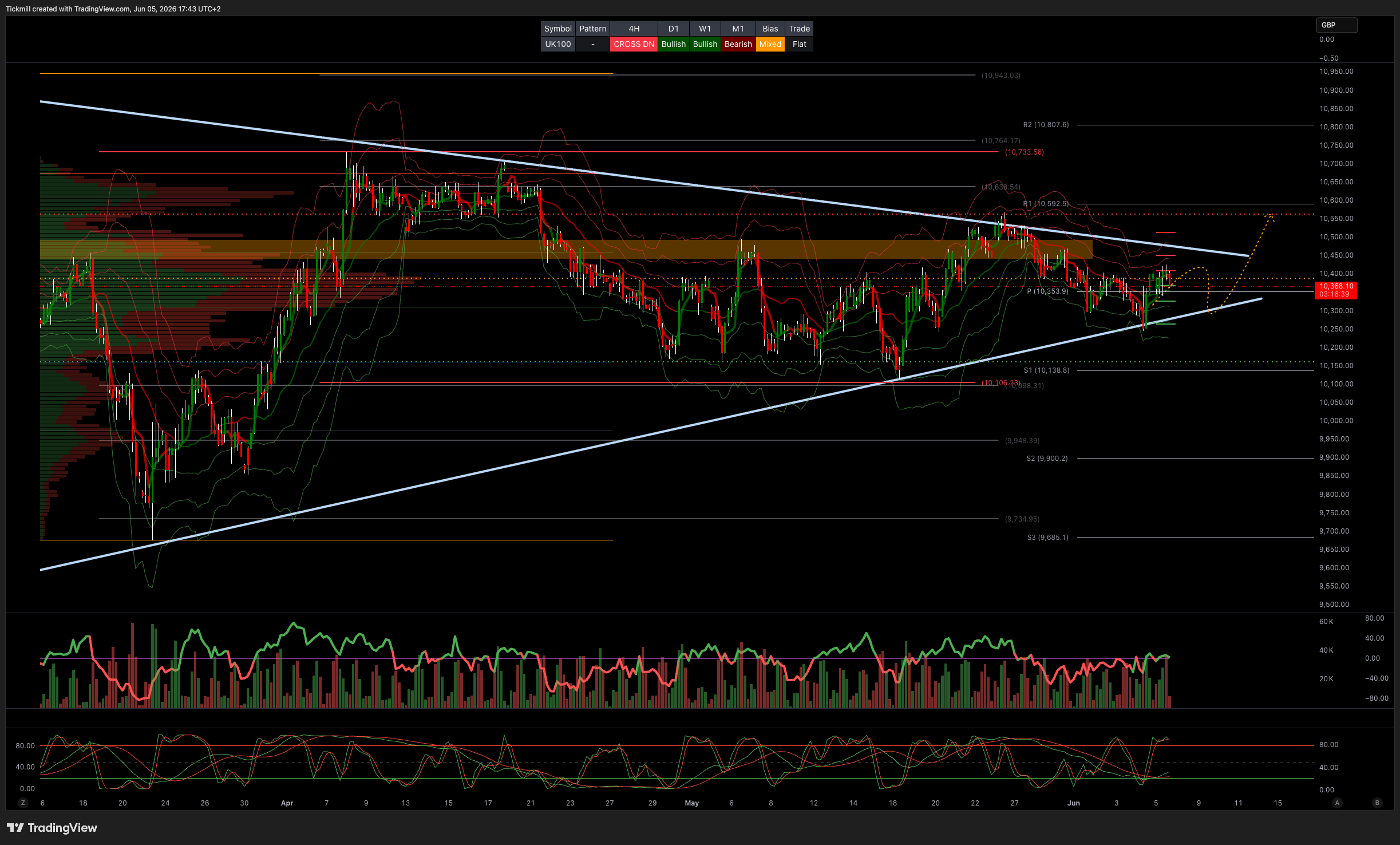
TECHNICAL & TRADE VIEW – FTSE100
Daily VWAP Bullish
Weekly VWAP Bullish
Above 10500 Target 11000
Below 10100 Target 9469
Disclaimer: The material provided is for information purposes only and should not be considered as investment advice. The views, information, or opinions expressed in the text belong solely to the author, and not to the author’s employer, organization, committee or other group or individual or company.
Past performance is not indicative of future results.
High Risk Warning: CFDs are complex instruments and come with a high risk of losing money rapidly due to leverage. 69% and 73% of retail investor accounts lose money when trading CFDs with Tickmill UK Ltd and Tickmill Europe Ltd respectively. You should consider whether you understand how CFDs work and whether you can afford to take the high risk of losing your money.
Futures and Options: Trading futures and options on margin carries a high degree of risk and may result in losses exceeding your initial investment. These products are not suitable for all investors. Ensure you fully understand the risks and take appropriate care to manage your risk.
Patrick has been involved in the financial markets for well over a decade as a self-educated professional trader and money manager. Flitting between the roles of market commentator, analyst and mentor, Patrick has improved the technical skills and psychological stance of literally hundreds of traders – coaching them to become savvy market operators!