Institutional Insights: JPMorgan Trading NFP's

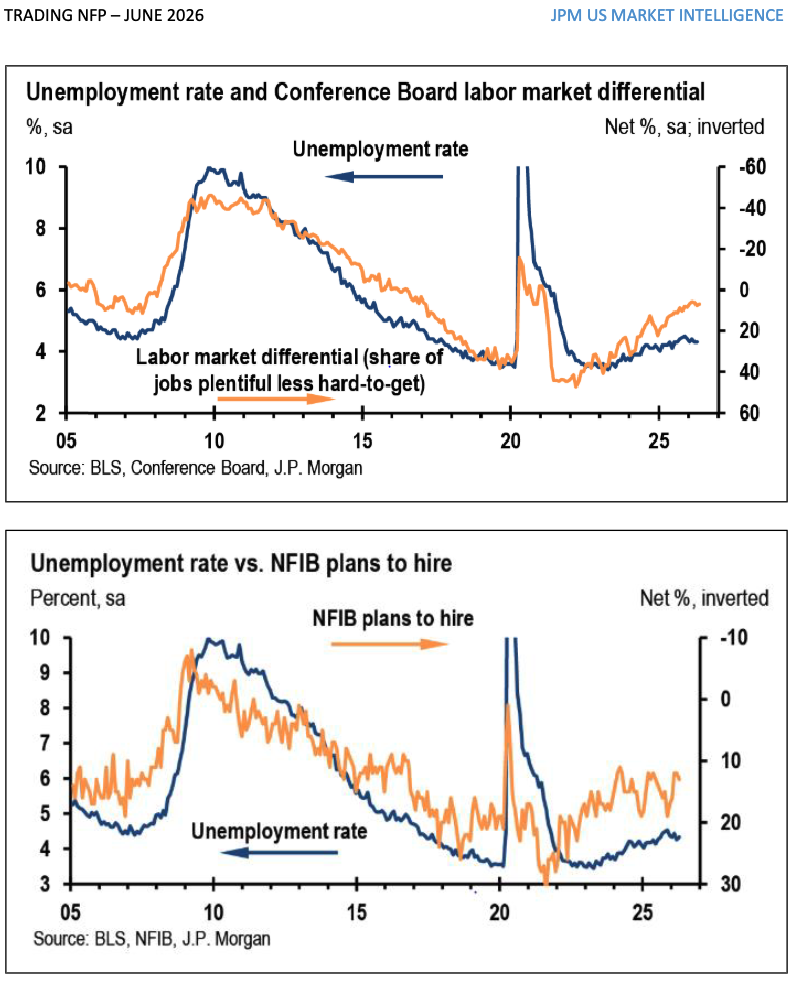
JPM’s US Market Intelligence NFP framework frames Friday’s payrolls report as important, but not dominant, because Middle East uncertainty and broader macro/geopolitical risk are still competing for market attention. The desk view is that the equity market’s reaction function is unusually balanced: a modestly soft print is likely best for equities, a very weak print risks reviving stagflation or growth-scare concerns, and a hot print can be either positive or negative depending on whether yields and bond volatility move materially higher.
Feroli’s economics team expects nonfarm payrolls to rise 75k in May versus the Street at 85k and the prior print at 115k. He expects the unemployment rate to hold at 4.3%, average hourly earnings to rise around 0.3% month over month and 3.4% year over year, and the workweek to remain unchanged at 34.3 hours. This forecast is modestly below consensus on headline payrolls but not dramatically weak, and it fits the broader idea that the labor market is cooling but not breaking.
The trading desk’s highest-probability scenario is a 70k to 100k payroll print, assigned a 40% probability. In that range, the desk expects the S&P 500 to gain 50bps to 1.0%. This is effectively the “goldilocks” zone: job growth is soft enough to avoid reigniting inflation and rates fears, but firm enough to avoid a hard-landing narrative. Given the market’s current setup, with the S&P near highs, volatility contained, buybacks active, CTAs still modest buyers, and Tech/AI leadership still powerful, this outcome would likely support another grind higher.
The second-best outcome is probably a 100k to 130k print, assigned a 25% probability, where the desk sees the S&P ranging from down 25bps to up 75bps. In this scenario, equities can still rally if the unemployment rate does not fall materially and wage growth remains contained. A hotter but not too hot payrolls print would reinforce the “economy is good and getting better” view. However, the upside would be capped if bond yields rise, because the market is already sensitive to higher rates given stretched large-cap Tech positioning, the recent momentum rebound, and elevated Nasdaq/AI valuations.
A very strong print above 130k is assigned only a 5% probability, with the S&P expected to range from down 1.0% to up 50bps. The wide range reflects the ambiguity of a hot number. If payroll strength comes with stable unemployment and benign wages, the market could treat it as a positive growth signal. But if the data push yields and bond volatility higher, equities would likely react negatively. In the current tape, a hot number would probably put the most pressure on long-duration growth, crowded AI winners, software, and high-momentum names, while potentially helping cyclicals and financials if the rates move is orderly.
A 40k to 70k payroll print is assigned a 25% probability, with the S&P expected to trade from down 75bps to flat. This is the awkward “too soft” zone. It may not be weak enough to trigger immediate recession panic, but it would undermine confidence in the labor market and could revive concerns about consumer spending, credit quality, and stagflation, especially with oil back above $90. In that scenario, equities could struggle because lower yields might not be enough to offset weaker growth concerns, particularly if the market interprets the data as evidence that the consumer is losing momentum.
A print below 40k is assigned only a 5% probability, but it is the clearly negative tail, with the desk expecting the S&P to lose 1.0% to 1.5%. This would likely bring back hard-landing or stagflationary concerns, especially if wage growth remains sticky or oil remains elevated. In that outcome, the market would probably de-risk more broadly, with small caps, consumer discretionary, lower-quality cyclicals, and high-beta momentum at risk. Defensive sectors might outperform on a relative basis, but the index would likely trade lower.
Options expiring June 5 were pricing roughly a 1.0% move as of the June 1 close. That is broadly consistent with the desk’s scenario ranges and suggests the market is not pricing a major payrolls shock. This lower-than-usual volatility around NFP reflects the idea that the report is important but not the only driver, with Middle East headlines, oil, AI-related factor rotation, buybacks, and positioning all playing major roles in the current market environment.
Feroli’s establishment-survey preview points to 85k private payroll growth, mildly above the six-month average of 68k but in line with the average since the start of the year. Payroll growth has exceeded 100k in three of the past four months, which leaves open the possibility that job growth is starting to run persistently above 100k again. However, Feroli remains cautious because breakeven payroll growth may be under 50k per month and perhaps closer to zero. That means even modest payroll gains may still be enough to stabilize the unemployment rate, especially if labor force growth is slowing.
Seasonality is another reason for caution. Over the prior 15 years, May payroll growth has typically been below the trailing three-month trend, and there may be a tendency for job growth to slow into the summer months. Revisions are also worth watching. May payrolls have been revised lower in recent years between the first and third prints, so even a decent initial number could later be marked down. This revision risk matters for trading because markets react to the initial print, but investors may discount a strong May number if they suspect it is vulnerable to future downward revisions.
Leading indicators are mixed but somewhat constructive. Initial claims continue to run below year-ago levels, and ADP has been pointing to stronger job growth for a second consecutive month. ADP private job growth in the four weeks to May 9 was 143k, and that metric has been above 100k every week since late March. However, ADP does not always track BLS month to month. Feroli notes that if one assumes May ADP job growth of 150k and applies ADP’s December-to-May percentage growth to BLS data, it would imply only a 60k increase in private BLS jobs in May. So the ADP signal is encouraging, but not conclusive.
Other labor indicators are more subdued. Regional Fed surveys improved slightly from April to May, and the Census BTOS data edged up versus year-ago levels. Indeed job openings and the Conference Board labor market differential were roughly unchanged, while Homebase data were a bit weak month over month, partly reflecting normalization after a decent April. Overall, the indicators do not point to a labor market collapse, but they also do not argue for a major reacceleration.
At the industry level, recent improvement has appeared in construction, manufacturing, trade/transportation/utilities, and professional and business services. Construction had been on a long uptrend, slowed since late 2024, and has more recently returned to growth. Manufacturing, trade/transportation/utilities, and professional services had been losing jobs but are now showing signs of stabilization. In manufacturing, the small jobs pickup is concentrated in durable goods employment, which aligns with signals from industrial production and factory orders. This matters for equities because stabilization in cyclically sensitive labor categories would support the “good and getting better” macro view.
One interesting point in Feroli’s preview is that recent job growth has been concentrated in industries with the highest non-citizen employment share, especially workers born in Latin America. Despite elevated immigration enforcement, those workers may have become more focused on finding work given limited savings, and immigration enforcement is less dominant in headlines now. Feroli’s industry-quantile analysis suggests the clearest slowdown and re-acceleration has occurred in the most immigration-exposed industries. This could help explain why payrolls have held up better than some softer labor-market surveys might imply.
For hours and wages, Feroli expects the workweek to remain stable at 34.3, where it has stayed for most of the past two years. Average hourly earnings are expected to accelerate slightly to around 0.25% month over month after a couple of soft months, pulling the year-over-year rate back to 3.4%. Wage data will be critical for the market reaction. A payroll print in the 70k to 130k range with wages at or below expectations would likely be taken well. A similar payroll number with a wage upside surprise would be less positive because it would raise inflation and Fed-risk concerns.
In the household survey, the unemployment rate is finely balanced. The unrounded unemployment rate was 4.337% in April, so the bar to round up to 4.4% is low. However, Feroli sees risks tilted more toward 4.2% than 4.4%. He argues that after peaking in November, the unemployment trend may now be moving lower, and continuing claims support that idea. The four-week average of continuing claims is near levels last seen in mid-2023, when unemployment was still in the high-3% range. That said, unemployment may not fall quickly because longer-term unemployed workers tend to lag turning points and often no longer qualify for unemployment insurance.
Feroli also expects labor force participation to decline from 61.8% to 61.7%, partly because the participation rate has been gradually falling and residual seasonality in the 16-to-24-year-old cohort could be a drag in May. A lower participation rate could help keep the unemployment rate stable or even lower despite moderate job growth. For markets, that creates some interpretive risk: a lower unemployment rate caused by weaker participation could still be read as labor-market tightness by rates markets, even if the growth signal is not especially strong.
The practical trading takeaway is that the market likely wants a payroll number between 70k and 100k, stable unemployment around 4.3%, and wage growth of 0.2% to 0.3% month over month. That combination would validate the soft-landing narrative, keep the Fed/rates pressure contained, and support the current equity flow backdrop. A 100k to 130k number can also work if wages and yields behave. The problematic outcomes are the tails: above 130k with higher yields and bond volatility, or below 70k with renewed growth and consumer concerns. Below 40k would likely be decisively risk-negative.
For positioning, this means the S&P’s reaction will depend less on the headline payroll number alone and more on the combination of payrolls, unemployment, wages, and the 10-year yield. If the number lands in the goldilocks range, the current winners can likely keep working: AI infrastructure, semis, cybersecurity, data infrastructure, and selective momentum. If the number is hot and yields rise, crowded large-cap Tech and high-duration software are most vulnerable. If the number is weak, the market may rotate toward quality defensives and away from small caps, consumer cyclicals, and lower-quality high-beta. The report is unlikely to overwhelm the broader tape by itself, but it can determine whether the current factor rotation continues smoothly or turns into a sharper de-risking event.
Disclaimer: The material provided is for information purposes only and should not be considered as investment advice. The views, information, or opinions expressed in the text belong solely to the author, and not to the author’s employer, organization, committee or other group or individual or company.
Past performance is not indicative of future results.
High Risk Warning: CFDs are complex instruments and come with a high risk of losing money rapidly due to leverage. 69% and 73% of retail investor accounts lose money when trading CFDs with Tickmill UK Ltd and Tickmill Europe Ltd respectively. You should consider whether you understand how CFDs work and whether you can afford to take the high risk of losing your money.
Futures and Options: Trading futures and options on margin carries a high degree of risk and may result in losses exceeding your initial investment. These products are not suitable for all investors. Ensure you fully understand the risks and take appropriate care to manage your risk.
Patrick has been involved in the financial markets for well over a decade as a self-educated professional trader and money manager. Flitting between the roles of market commentator, analyst and mentor, Patrick has improved the technical skills and psychological stance of literally hundreds of traders – coaching them to become savvy market operators!