Institutional Insights: RBC Capital Markets ' Depressed Sentiment Pays'

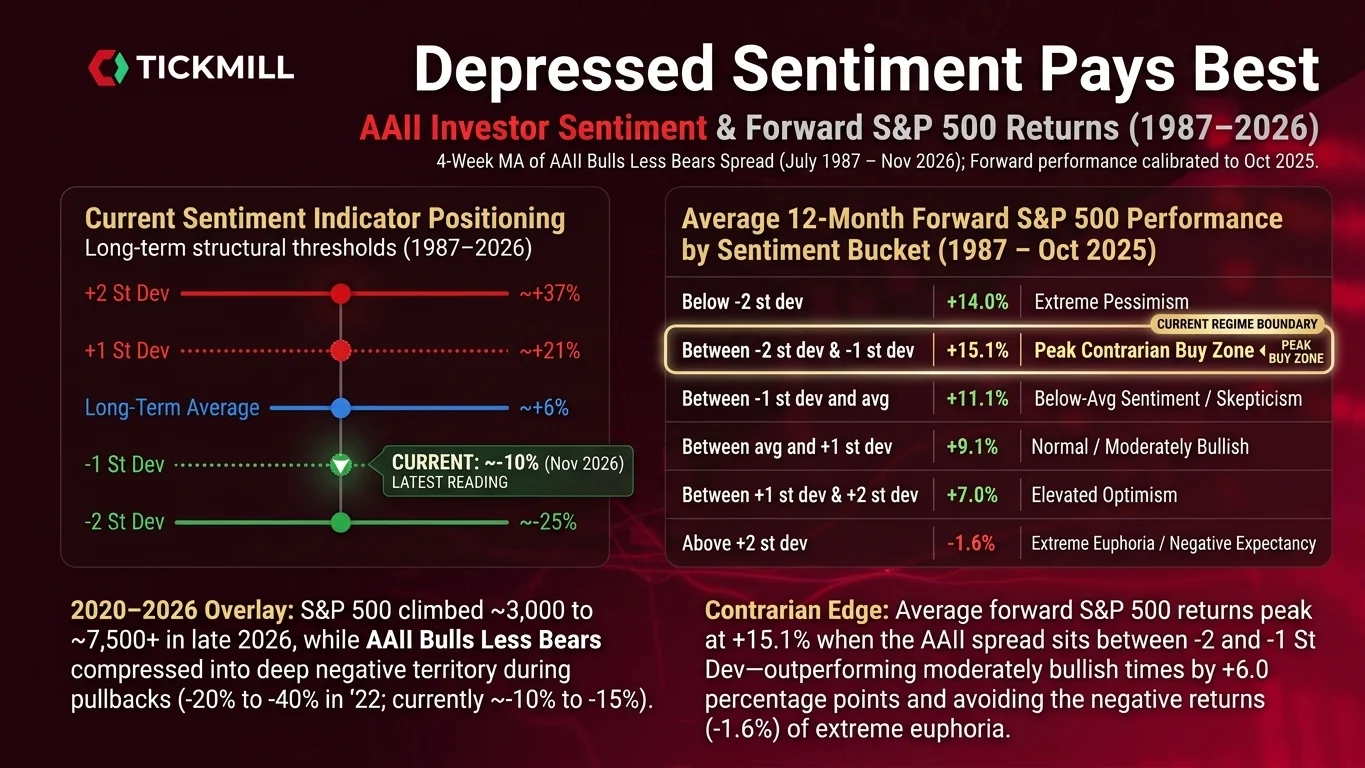
AAII Investor Sentiment & Forward S&P 500 Returns (1987–2026)
Dataset: Four-week moving average of the AAII Bulls Less Bears spread (Bulls - Bears) from July 1987 through November 2026 (with forward S&P 500 performance buckets calibrated on 1987 to October 2025 data).
1. Current Sentiment Indicator Positioning
Latest Weekly Reading (4-Week Avg AAII Bulls Less Bears): ~-10% (sitting directly on the -1 Standard Deviation below long-term average dotted green threshold)
Long-Term Structural Thresholds (1987–2026):
+2 St Dev Above LT Avg (Solid Red): ~+37%
+1 St Dev Above LT Avg (Dotted Red): ~+21%
Long-Term Average (Solid Blue): ~+6%
-1 St Dev Below LT Avg (Dotted Green): ~-10% (current reading)
-2 St Dev Below LT Avg (Solid Green): ~-25%
2. Average 12-Month Forward S&P 500 Performance by Sentiment Bucket (1987 – Oct 2025)
AAII Sentiment Indicator Bucket | Average 12-Month Forward S&P 500 Return | Regime Classification |
Below -2 st dev | +14.0% | Extreme Pessimism / Capitulation |
Between -2 st dev & -1 st dev (Highlighted) | +15.1% | Peak Contrarian Buy Zone (Current Regime Boundary) |
Between -1 st dev and avg | +11.1% | Below-Average Sentiment / Skepticism |
Between avg and +1 st dev | +9.1% | Normal / Moderately Bullish |
Between +1 st dev & +2 st dev | +7.0% | Elevated Optimism |
Above +2 st dev | -1.6% | Extreme Euphoria / Negative Expectancy |
3. Recent Cycle Trajectory (2020–2026 Overlay) & Strategic Takeaway
2020–2026 Overlay (
AAII Bulls Less Bears vs. SPX Performance): While the S&P 500 climbed from ~3,000 in 2020 to ~7,500+ in late 2026, weekly net bulls repeatedly compressed into negative territory (-20% to -40%) during the 2022 bear market, early 2025 tariff/growth scare, and the late-2026 pullback (currently near -10% to -15% weekly).Contrarian Edge: Average 12-month forward S&P 500 returns peak at +15.1% when the 4-week AAII spread sits between -2 and -1 standard deviations, outperforming the "between avg and +1 st dev" regime (+9.1%) by +6.0 percentage points and avoiding the negative forward expectancy (-1.6%) seen above +2 standard deviations.
Disclaimer: The material provided is for information purposes only and should not be considered as investment advice. The views, information, or opinions expressed in the text belong solely to the author, and not to the author’s employer, organization, committee or other group or individual or company.
Past performance is not indicative of future results.
High Risk Warning: CFDs are complex instruments and come with a high risk of losing money rapidly due to leverage. 68% and 74% of retail investor accounts lose money when trading CFDs with Tickmill UK Ltd and Tickmill Europe Ltd respectively. You should consider whether you understand how CFDs work and whether you can afford to take the high risk of losing your money.
Futures and Options: Trading futures and options on margin carries a high degree of risk and may result in losses exceeding your initial investment. These products are not suitable for all investors. Ensure you fully understand the risks and take appropriate care to manage your risk.
Patrick has been involved in the financial markets for well over a decade as a self-educated professional trader and money manager. Flitting between the roles of market commentator, analyst and mentor, Patrick has improved the technical skills and psychological stance of literally hundreds of traders – coaching them to become savvy market operators!