S&P500 Daily Action Areas & Price Targets 11/11/26

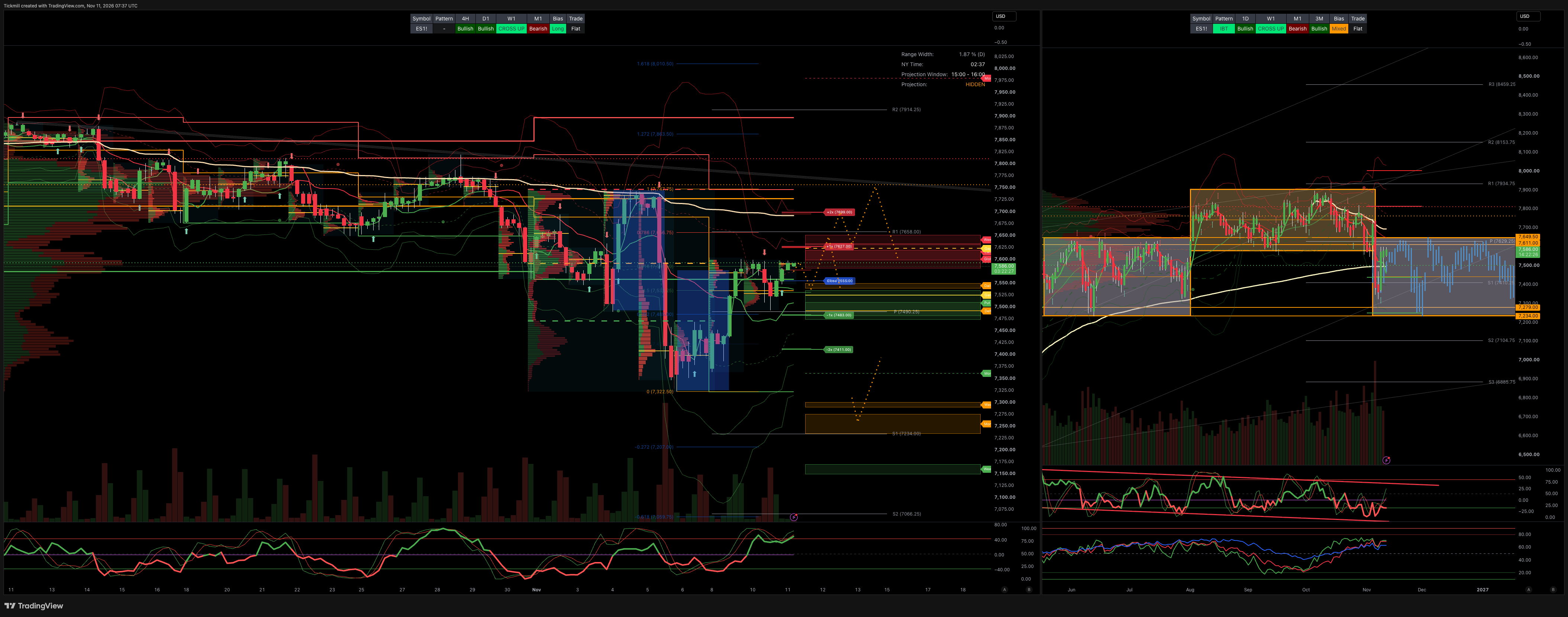
S&P500 Daily Action Areas & Price Targets 11/11/26
***QUOTING ES1!(Z CONTRACT LEVLES) FOR CASH US500 EQUIVALENT LEVELS, SUBTRACT POINT DIFFERENCE***
MONTHLY-WEEKLY& DAILY LEVELS
MONTHLY BULL BEAR ZONE 7275/35
MONTHLY RANGE RES 7980 SUP 7361
WEEKLY BULL BEAR ZONE 7300/7290
WEEKLY RANGE RES 7631/51 SUP 7170/50
DAILY BULL BEAR ZONE 7540/50
GLOBEX RANGE SUP 7510/7474 RES 7582/7619
GAMMA FLIP 7525
DELTA FLIP 7492
CALL WALLS 7599/7633
PUT WALLS 7535/7482
DAILY STRUCTURE - BALANCE 76000/7455
WEEKLY STRUCTURE - OTFL - 7746
MONTHLY STRUCTURE - TBC
VIX BULL BEAR ZONE 18.72
VVIX-to-VIX ratio, currently hovering at approximately 4.97, comfortably falls within the historically typical range of 4.0 to 6.0. This suggests that volatility expectations are in a neutral zone, reflecting neither panic nor extreme contrarian sentiments.
PRIMARY TRADES & TARGETS
LONG ON REJECT/RECLAIM DBBZ TARGET RTH CLOSE>DAILY RANGE RES
***ADDITIONAL SETUPS & TARGETS HIGHLIGHTED ON THE CHARTS***
(I FADE TESTS OF 2 SIGMA LEVELS ESPECIALLY INTO THE FINAL HOUR OF THE NY CASH SESSION AS 90% OF THE TIME WHEN TESTED THE MARKET WILL CLOSE ABOVE OR BELOW THESE LEVELS)
SPX PUT/CALL RATIO 1.11 (The numbers reflect options traded during the current session.) A put-call ratio below 0.7 is generally considered bullish, and a put-call ratio above 1.0 is generally considered bearish.
JHEQX Upside cap (~7,920–7,950): Dealer gamma hedging at this call strike creates resistance, with market makers likely selling futures into strength and limiting volatility. Downside cushion (~7,270): If SPX drops 5% into Q4, long put gamma may force dealers to buy futures as the index falls, helping stabilize prices. Expiration: December 31, 2026. Strong pinning effects are likely near key strikes into year-end expiration.
DEC2025 OPEX to DEC2026 OPEX is 945 points giving us a range of [5889,7779]
Notes On Structure Implications
Balance: This refers to a market condition where prices move within a defined range, reflecting uncertainty as participants await further market-generated information. Our approach to balance includes favouring fade trades at the range extremes (highs/lows) while preparing for potential breakout scenarios if the balance shifts.
One-Time Framing Higher (OTFH): This represents a market trend where each successive bar forms a higher low, signalling a strong and consistent upward movement.
One-Time Framing Lower (OTFL): This describes a market trend where each successive bar forms a lower high, indicating a pronounced and steady downward movement.
J.P. Morgan Equity Market Intelligence & Delta-One / Thematics Strategy
REAL YIELDS SURGE ON HOT CORE CPI (+0.30% M/M) AS HAWKISH FED CHORUS SHAKES EQUITY DURATION
US equities ended Tuesday lower (S&P 500 -0.4%, Nasdaq-100 -0.6%, Russell 2000 -0.7%) but closed significantly off intraday lows after absorbing a dual macro shock: an upside surprise in October CPI accompanied by an aggressive barrage of hawkish Fedspeak (led by Waller putting a 50 bps December hike into play).
Importantly, cross-asset analysis shows the post-CPI sell-off was driven almost entirely by surging real yields rather than runaway inflation expectations, with the US 10-Year yield marching back to 4.985% (+11 bps on the session). Higher real yields supported a sharp dollar rebound, which weighed heavily on precious and base metals (Gold -2.61% to $4,032/oz, Silver -3.55% to $51.52/oz, Copper -1.6%).
Beneath the headline indices, the structural rotation continued: S&P 500 ex-AI (JPUSXAI) outperformed the headline index by ~50 bps, driven by single-stock idiosyncratic supply in Nvidia (NVDA -6.5% on regulatory/export-control headlines, accounting for one-third of the NDX drawdown) and memory, while capital rotated into Comm Services, Consumer Discretionary, and Healthcare.
CROSS-ASSET BENCHMARK DASHBOARD
S&P 500 (SPX): Closed -0.4% | Rebounded from session lows; ex-AI spread widened +50 bps
Nasdaq-100 (NDX): Closed -0.6% | NVDA (-6.5%) drove ~33% of benchmark decline
Russell 2000 (RUT): Closed -0.7% | High-beta, levered small-caps hit hardest by duration reset
Dow Jones (DJI): Outperformed broad tape on defensive and value tilts
US 10-Year Treasury Yield: Rose to 4.985% (testing the critical 5.00% benchmark handle)
VIX: Closed at 19.59 (down from last week's panic highs, but term structure remains sticky)
WTI Crude: Down -56 bps to $86.36/bbl | Middle East de-escalation holding price deck sub-$87
Natural Gas: US NatGas +2.83% to $3.31/MMBtu | UK NatGas +3.47% to £2.1234/therm
Gold: Dropped -2.61% to $4,032.00/oz | Liquidated on surging USD and real rate yields
Silver: Slid -3.55% to $51.52/oz
European Indices: Outperformed US peers on cheaper energy inputs (DAX +0.3%, SX5E +0.6%, UKX -0.3%)
MACRO & INFLATION TEARDOWN: OCTOBER CPI (ABIEL REINHART)
The Print: Core CPI printed +0.30% MoM (vs. JPM 0.23% forecast) and Headline CPI rose +0.35% MoM, confirming inflation remains uncomfortably hot and broad-based. (YoY comparisons remain unavailable due to distortions from the autumn 2025 government shutdown).
Core PCE Read-Through: JPM projects October Core PCE at +0.35% MoM, which will elevate the annual pace back to 3.3% YoY (the fastest since 2023) and push the 3-month annualized run-rate to 3.8% SAAR.
Sub-Component Decomposition:
Services: The primary source of upside error. Owners' Equivalent Rent (OER) remained firm at +0.32%, Motor Vehicle Insurance spiked +0.7%, Healthcare rose +0.3%, and Recreation Services surged +0.9% across broad categories.
Goods: Core goods rose +0.16%; used cars dropped -1.2%, but this was fully eclipsed by large spikes in Household Furnishings (+0.7%), Recreation Commodities (+0.7%), and persistent tech/electronics inflation. Food jumped +0.5%.
Market Intel Take: While the market swiftly priced in an elevated probability of a 50 bps Fed hike in December, desk strategists doubt 50 bps will gain majority consensus given the counterbalancing deflationary impulse of declining crude oil ($86/bbl) and moderating hyperscaler capex growth.
FEDSPEAK TRACKER: UNIFIED HAWKISH COUNTERATTACK
Christopher Waller: Backed a December hike and stated he is explicitly open to a 50 bps move if inflation persistence requires it; stated the Fed must, at minimum, "take back the 3 insurance cuts."
Lorie Logan: Stated current policy is still accommodative rather than restraining; warned that faster rate hikes may be necessary this winter, advocating for a pause only after two more rate hikes.
Michelle Bowman: Flagged direct financial stability risks of a large correction in equity multiples, especially if enterprise returns on AI capital spending disappoint.
Jeffrey Schmid: Reiterated the Fed benchmark rate remains fairly accommodative today, citing strong underlying demand.
MACRO RESEARCH: LABOR PRODUCTIVITY & SMALL BUSINESS PRESSURE
Productivity & AI Mechanics (Joe Lupton): Dismisses the popular thesis that the US is in a permanent "jobless AI-driven productivity boom." Lupton demonstrates that recent productivity gains stem from cyclical capital deepening and higher factor utilization rather than realized tech efficiency leaps. As a result, hiring must cyclically rebound, keeping wages sticky, inflation elevated, and Fed rates higher for longer.
NFIB Small Business Survey Reality:
Hiring Intentions Surge: The Hiring sub-index rose again; historically, this leads Non-Farm Payrolls by 1–3 months. 86% of owners reported few or no qualified applicants.
Wage & Pricing Pressure: Labor availability is the #1 issue facing businesses. 33% of owners raised average selling prices (vs. 14% historical average), and 37% plan price hikes over the next 3 months (highest reading since July 2022).
Top Business Obstacles: (1) Labor quality/availability, (2) Inflation, (3) Taxes, (4) Regulation, (5) Insurance.
TECHNICALS & RESISTANCE BARRIERS (JASON HUNTER)
J.P. Morgan Technical Strategy cautions that the sharp rebounds across the semiconductor and tech complexes have occurred without a complete capitulation or tactical basing process (AAII and Daily Sentiment bulls sit in the low-to-mid 30% range, well above deep oversold extremes):
Philadelphia Semiconductor Index (
SOX):First Resistance Band: 10,445 – 10,895 (incorporating the 200-day moving average at 10,851). Derails bearish momentum, but does not flip trend.
Trend Reversal Pivot: A confirmed breakout above 11,600 – 12,000 is required to flip medium-term trend momentum back to positive.
Nasdaq-100 (
NDX):First Resistance: 200-day moving average at 28,004 (cash closed Tuesday at 27,907).
Major Supply Zone: 28,750 – 30,000 (where heavy overhead volume resides).
S&P 500 (
SPX):Spot closed at 7,549, whipsawing directly around the 7,500–7,600 threshold. Must clear and hold 7,600 to abort the developing short-term downtrend.
Medium-Term Support: The 7,235 – 7,330 band remains primary downside support.
TRADING DESK & THEMATIC FLOW INTELLIGENCE
ETF Flow Desk (Jon Rogerson):
Desks finished skewed better to buy, anchored by real-money demand into Emerging Markets (
VWO), Communication Services (XLC), and Energy (XLE).Real money exited International Developed (
VEA) and Total US Market (VTI).Observed violent short squeezes in levered inverse products:
SOXS(3x Short Semis) saw long seller capitulation at -21% on the day, showing extreme two-way whipsaw risk.Gold miners (
GDX/GDXJ) saw steady real-money accumulator buying despite bullion weakness.
TMT Equity Desk (Brian Heavey):
Nvidia Outflows: Institutional supply accelerated following The Information article alleging executive awareness of chip sales to Chinese shell companies. Flow rotated out of pure semis/memory and directly into balance-sheet-rich Hyperscalers.
High-touch TMT volume ran +20% vs. 5-day averages. Info Tech was the largest net sold sector in the room.
Delta-One / Factors (Kaitlyn Bowman & Manish Sinha):
Stealth Rates Trade: Long Repair & Remodel (
JPUXRR) vs. Short Homebuilders (JP2HOME) broke out (+2.1 SD), as 5.00% mortgage rates lock in homeowners, driving renovation spend over new home purchases.Late-Stage AI Rotation: The S&P ex-AI index (
JPUSXAI) has now outperformed headline SPX by >5.0%. While ex-AI provides 1–2 vols lower realized volatility, it remains vulnerable to high benchmark interest rates if broader economic demand slows.
Financials Desk (Rob O’Dwyer):
Synchrony Financial (
SYF) noted steady credit resilience and no 2027 recession baseline, but desk strategists warn that at 7x NTM EPS, consumer finance shares are not cheap enough (5x historical troughs) to withstand potential regulatory rate caps and incremental Fed rate hikes.
Commodities (Kevin Brush):
Base metals softened under USD strength. Copper fell -1.6%, narrowing LME Cash/3s spreads to $110b (from $175b) on CTA selling.
Aluminium fell -1.8%, pressured by 2 consecutive days of onshore stock builds on the Shanghai Futures Exchange (SHFE open interest jumped +15%).
Disclaimer: The material provided is for information purposes only and should not be considered as investment advice. The views, information, or opinions expressed in the text belong solely to the author, and not to the author’s employer, organization, committee or other group or individual or company.
Past performance is not indicative of future results.
High Risk Warning: CFDs are complex instruments and come with a high risk of losing money rapidly due to leverage. 68% and 74% of retail investor accounts lose money when trading CFDs with Tickmill UK Ltd and Tickmill Europe Ltd respectively. You should consider whether you understand how CFDs work and whether you can afford to take the high risk of losing your money.
Futures and Options: Trading futures and options on margin carries a high degree of risk and may result in losses exceeding your initial investment. These products are not suitable for all investors. Ensure you fully understand the risks and take appropriate care to manage your risk.
Patrick has been involved in the financial markets for well over a decade as a self-educated professional trader and money manager. Flitting between the roles of market commentator, analyst and mentor, Patrick has improved the technical skills and psychological stance of literally hundreds of traders – coaching them to become savvy market operators!