Common Mistakes Traders Make When Trading SpaceX CFDs
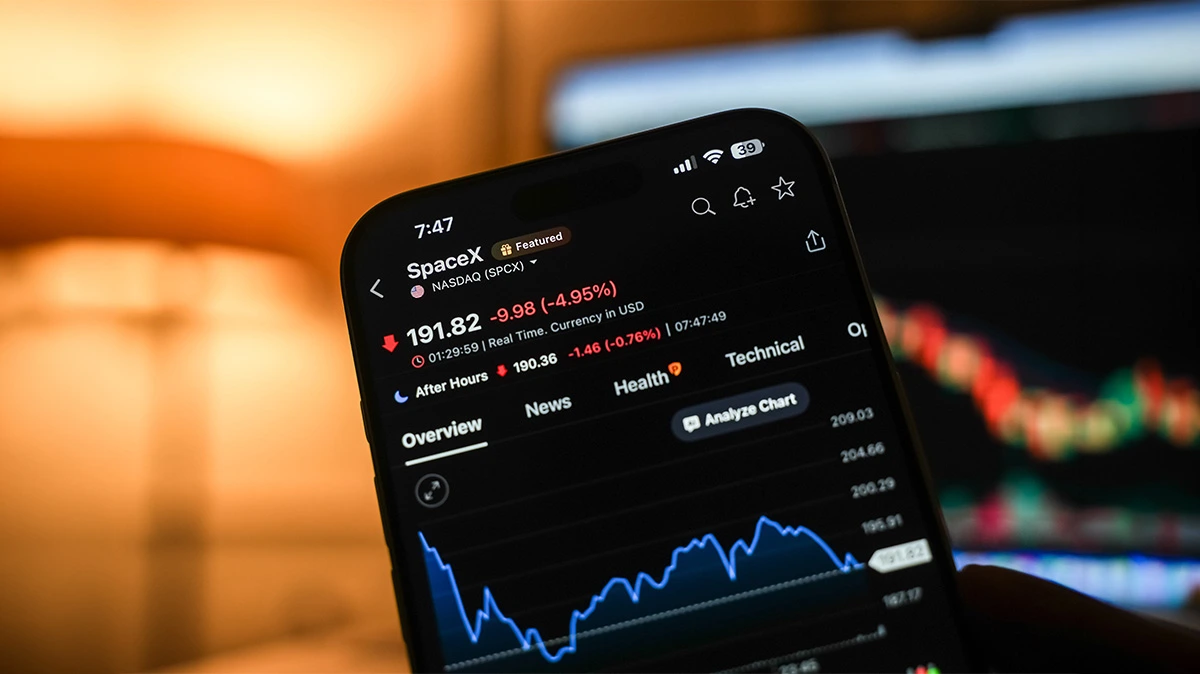
SpaceX's long-awaited Nasdaq debut has quickly evolved from a landmark public offering into one of the defining market stories of the year. The stock's arrival has attracted intense institutional and retail participation, with investors attempting to assess not only the company's valuation, but also how its unique combination of launch services, Starlink, national security contracts and next-generation Starship development should be priced relative to traditional aerospace and high-growth technology companies.
At Tickmill, we have seen growing interest from traders seeking exposure to SpaceX through Contracts for Difference (CFDs). While trading approaches inevitably differ, periods like these consistently reinforce the same principle: sustained performance is rarely achieved by chasing headlines. It comes from understanding the catalysts driving market sentiment, recognising how volatility evolves around major events, and approaching each opportunity with a disciplined risk-management framework.
Below are some of the most common mistakes traders make when approaching flagship listings such as SpaceX and how experienced market participants typically navigate them. Tickmill ensures that all traders have access to education, transparent and fair conditions, so they can explore the markets with confidence.
SpaceX Fun Facts
Founded in 2002 by Elon Musk.
SpaceX is headquartered in Starbase, Texas.
SpaceX’s stated goals were to revolutionise the aerospace industry and to make spaceflight more affordable.
SpaceX’s first rocket was the Falcon 1.
SpaceX is a public company. It completed its IPO in June 2026 at $135 a share.
Mistake 1: Trading the Headlines Instead of the Price Action
Few market events generate as much attention as the public listing of a company like SpaceX. In the days surrounding its debut, analyst upgrades, valuation changes and social media speculation often dominate headlines.
However, markets rarely react to news alone. By the time major developments are widely reported, expectations are often already reflected in the share price. For high-profile listings, institutional positioning, options activity and market liquidity can have a greater impact on short-term price movements than the headlines themselves.
For CFD traders, separating market narrative from actual price behaviour is essential. Rather than reacting to positive or negative news, experienced traders focus on price action, volatility and whether current conditions support their overall trading strategy.
Mistake 2: Underestimating Volatility
Newly listed companies rarely trade like established blue-chip stocks. During the price discovery phase following an IPO, institutional positioning, analyst revisions, and new market information can all contribute to heightened volatility and sharp intraday price swings.
For CFD traders, this creates opportunities to trade both rising and falling markets. However, increased volatility also means risk can escalate quickly if markets move unexpectedly.
Experienced traders typically focus on risk management by:
Sizing positions appropriately to avoid overexposure.
Using stop-loss orders to help limit potential downside.
Planning exits in advance rather than making decisions emotionally.
Keeping each trade proportionate to their overall portfolio risk.
In fast-moving markets, disciplined risk management is often just as important as identifying trading opportunities.
Mistake 3: Leverage: Amplifying Exposure, Not Edge
Leverage is a defining feature of CFD trading, allowing traders to gain greater market exposure with a relatively small initial margin. However, it should be viewed as a risk management tool rather than a trading advantage.
Experienced traders focus on position sizing based on overall portfolio risk, not the maximum leverage available. This is especially important when trading newly listed stocks, where volatility can increase rapidly during price discovery. Understanding margin requirements and potential downside scenarios is essential for maintaining effective risk management.
Mistake 4: Trading Without a Plan
Preparation is what often separates disciplined trading from reactive decision-making. Before entering a position, experienced traders define their entry and exit points, risk limits and potential scenarios.
This framework helps manage uncertainty rather than predict outcomes, reducing emotional decision-making during volatile markets. For newly listed stocks, where price swings can be significant, having a clear trading plan is especially important.
Mistake 5: Ignoring the Macro Environment
While companies like SpaceX often dominate headlines, their share prices are still influenced by broader market conditions. Factors such as liquidity, investor sentiment, inflation, interest rates and technology sector performance all play an important role.
For active traders, following both economic events and company-specific news provides better context for market volatility and helps avoid reacting to isolated price movements.
Mistake 6: Choosing a Platform Without the Right Trading Tools
During periods of high market activity, execution quality and platform reliability are just as important as trade direction. Experienced traders typically look for:
Fast execution and competitive spreads.
A regulated broker with client fund protection.
Advanced platforms such as MetaTrader 4 and MetaTrader 5.
Mobile trading access.
Research and educational resources.
While the right tools cannot eliminate risk, they can help traders make more informed decisions in fast-moving markets.
A Measured Approach to Participation in SpaceX CFDs
Interest in SpaceX and other listed high-profile equities is likely to persist as price discovery continues and as broader macro conditions evolve.
Experienced traders focus on preparation—testing strategies, understanding volatility and refining execution—rather than trying to predict every market move. Major market events create both opportunity and uncertainty but disciplined preparation can help traders navigate changing conditions. At Tickmill, traders can access SpaceX CFDs, use professional analytical tools, and practise trading in a demo environment before considering live trading.
Disclaimer: The material provided is for information purposes only and should not be considered as investment advice. The views, information, or opinions expressed in the text belong solely to the author, and not to the author’s employer, organization, committee or other group or individual or company.
Past performance is not indicative of future results.
High Risk Warning: CFDs are complex instruments and come with a high risk of losing money rapidly due to leverage. 68% and 74% of retail investor accounts lose money when trading CFDs with Tickmill UK Ltd and Tickmill Europe Ltd respectively. You should consider whether you understand how CFDs work and whether you can afford to take the high risk of losing your money.
Futures and Options: Trading futures and options on margin carries a high degree of risk and may result in losses exceeding your initial investment. These products are not suitable for all investors. Ensure you fully understand the risks and take appropriate care to manage your risk.