FTSE Mixed as CPI Rises but Core Pressure Cools
FTSE Mixed as CPI Rises but Core Pressure Cools
U.K. stocks were mixed on Wednesday as investors digested a widely expected rise in inflation, weighed shifting Middle East risks and watched global bond-market developments ahead of the FOMC minutes. The FTSE 100 struggled for clear direction but managed to reclaim positive territory into the close, with gains in selected energy, travel, healthcare and mining names offset by weakness in banks, insurers, financials and rate-sensitive stocks.
Sentiment found some support from Wall Street’s stronger Tuesday session after the U.S. Treasury signaled it would increase buybacks of notes and bonds. The Treasury said it would double the limit on buybacks of longer-term securities as part of efforts to ease pressure from the recent surge in long-dated borrowing costs. Lower long-end yield pressure, together with the prospect of higher dollar liquidity from Treasury intervention, helped support equities globally.
U.S. yields remained in focus ahead of the FOMC minutes. Markets are watching for any confirmation that softer U.S. inflation, weaker consumer data and Treasury liquidity support can reduce pressure on long-duration assets. That matters for London too, because global yield moves continue to influence UK banks, property stocks, housebuilders and investment trusts.
The main domestic event was the UK CPI release. Headline inflation rose to 2.9% year-on-year in July, from 2.6% in June. The reading was broadly in line with market expectations, slightly above the Bank of England’s 2.8% forecast and just below a 3.0% estimate. It marked the first increase in headline inflation since March.
The rise was widely expected and mainly reflected the latest Ofgem energy price-cap reset, which lifted typical annual household energy bills by around 13%. This was the first meaningful pass-through from the earlier rise in wholesale energy prices after tensions escalated in the Middle East. In other words, the headline inflation increase looked largely energy-driven rather than broad-based.
There was also some relief in the detail. A smaller-than-usual increase in air fares during July helped offset part of the energy-related increase. More importantly, underlying inflation pressures remained contained. Core inflation was unchanged at 2.6%, while services inflation eased from 3.6% to 3.4%.
That combination supports the Bank of England’s cautious stance. Headline inflation has risen, but the more policy-relevant core and services measures are not flashing the same warning signal. If services inflation continues to moderate, the BoE can argue that the energy-price shock is temporary and should not require an immediate policy response.
Bank stocks weakened on expectations that the BoE will maintain interest rates despite the higher headline CPI print. Standard Chartered, Lloyds Banking Group and NatWest moved lower, while financial names also struggled more broadly. A hold narrative can weigh on banks if investors reduce expectations for higher net interest margins, especially when the growth outlook remains only moderately positive.
Smith & Nephew fell 4% after announcing that CFO John Rogers had resigned from the board with immediate effect to pursue a new position in the United States. The move added to recent pressure on the medical technology group after earlier concerns around U.S. orthopaedics demand and guidance.
IG Group Holdings declined 3.4%, while Entain lost 2.7%. Other fallers included M&G, Persimmon, Halma, Aviva, Hiscox, Barratt Redrow, Marks & Spencer, Pershing Square Holdings, RELX, Experian, National Grid and Spirax Group, which shed between 1% and 1.8%.
The losses in Persimmon and Barratt Redrow showed that housebuilders remained vulnerable even as underlying inflation cooled. The issue is not only Bank Rate, but also mortgage affordability, consumer confidence and uncertainty over whether gilt yields can stay contained while the BoE continues quantitative tightening.
Insurers such as Aviva and Hiscox also weakened, while M&G fell with broader financials. The move suggested investors were trimming exposure to rate-sensitive and financial stocks ahead of further clarity from the FOMC minutes and Friday’s UK borrowing, retail sales and PMI data.
There were some gainers. Weir Group advanced 1.1%, while IAG, AstraZeneca, Scottish Mortgage, Admiral, B&M, Croda, Sainsbury, Rio Tinto, Next, Shell and Airtel Africa rose between 0.5% and 1%.
The rise in Shell reflected continued support from elevated oil prices and Middle East uncertainty. Energy remains a defensive hedge within the FTSE when geopolitical risks rise, though it also keeps inflation concerns alive for consumers and policymakers.
AstraZeneca’s gain added to recent support after positive SAFFRON Phase III trial results. IAG’s move suggested some relief from the softer air-fare component in the CPI data, though the sector remains exposed to fuel costs and geopolitical disruption.
Retail performance was mixed. Sainsbury and Next gained, while Marks & Spencer fell. That split showed investors are becoming more selective ahead of Friday’s retail sales figures, which will be important after recent softer BRC data but stronger Q2 household consumption.
The macro takeaway is that the inflation print was uncomfortable at the headline level but reassuring underneath. The increase to 2.9% confirms that energy shocks are feeding into household bills, but unchanged core inflation and softer services inflation reduce the risk of an immediate BoE pivot toward tighter policy.
Finish Line: The FTSE 100 was mixed as UK headline CPI rose to 2.9%, slightly above the BoE’s forecast, but core inflation held at 2.6% and services inflation eased to 3.4%. That kept expectations tilted toward a Bank of England hold, weighing on banks and financials. Smith & Nephew dropped after its CFO resigned, while IG Group and Entain also fell. Gains in Shell, AstraZeneca, IAG, Rio Tinto and selected retailers helped limit the damage. The market’s message was cautious but not alarmed: inflation is higher because of energy, but underlying price pressure is still cooling.
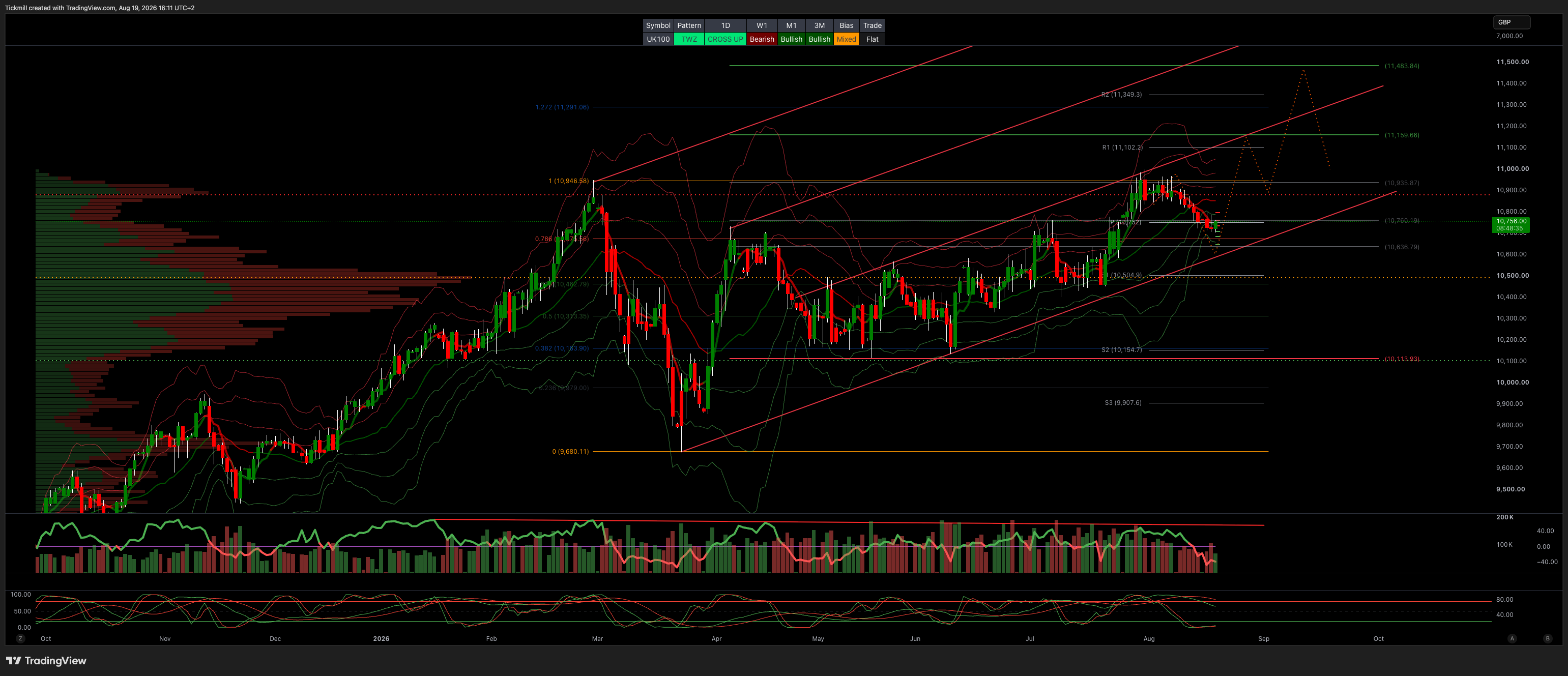
TECHNICAL & TRADE VIEW – FTSE100
Daily VWAP Bearish>Bullish
Weekly VWAP Bearish
Above 10700 Target 11150
Below 10400 Target 9500
Disclaimer: The material provided is for information purposes only and should not be considered as investment advice. The views, information, or opinions expressed in the text belong solely to the author, and not to the author’s employer, organization, committee or other group or individual or company.
Past performance is not indicative of future results.
High Risk Warning: CFDs are complex instruments and come with a high risk of losing money rapidly due to leverage. 68% and 74% of retail investor accounts lose money when trading CFDs with Tickmill UK Ltd and Tickmill Europe Ltd respectively. You should consider whether you understand how CFDs work and whether you can afford to take the high risk of losing your money.
Futures and Options: Trading futures and options on margin carries a high degree of risk and may result in losses exceeding your initial investment. These products are not suitable for all investors. Ensure you fully understand the risks and take appropriate care to manage your risk.
Patrick has been involved in the financial markets for well over a decade as a self-educated professional trader and money manager. Flitting between the roles of market commentator, analyst and mentor, Patrick has improved the technical skills and psychological stance of literally hundreds of traders – coaching them to become savvy market operators!